
Spot On K9 Sports

Fun activities for all dogs

Thu Agility Class Courses

Although the courses are numbered here, I deliberately did not number them for my students to encourage them to use muscle memory instead of relying on or being distracted by numbered cones littered throughout the course.

Across the board, with all four classes tonight, the biggest challenge I saw was keeping the dog’s focus. For one team, I suggested that the handler ask her dog to perform basic obedience cues such as sit, down, watch me or tricks so they could be connected right at the start line. Staying connected is much more important than accurately following the course.

If you didn’t set your dog up at a slight angle in line with #2 jump, and didn’t have a start line stay, dogs turned back toward their handler and missed the #2 jump. Some handlers managed with a push, which wasn’t pretty. I prefer setting the dog up to see the second obstacle and a solid start line stay. We discussed the importance of regularly reinforcing the sit stay rather than waiting for the dog to fail (i.e. self release) and correcting him for it.

For Excellent/Masters course, front crosses after the teeter and landing side #6 jump tightened up the line. Several dogs were not cued to turn tightly coming out of the chute and took the backside of #16 (red)/#17 (black) nonwinged jump.

For Open/Advanced course, I specifically asked the students to stay on the right side of the dogwalk so they could practice rear crossing #10 jump. In some cases, the rear cross was successful, but the handler pushed the dog so far out that he missed #11 jump. For those handlers whose dogs did not read the rear cross, I suggested an exercise that can be done without equipment. First, ask dog to sit in heel position and tell them stay. Cross behind them and reward if dog remains in a sit and just turns his head to left. Repeat with dog starting on right side.

The straight line of #13-15 (red)/#14-16 (black) proved difficult for green dogs who aren’t yet confident about sending ahead to obstacles, or dogs whose handlers had to babysit the Aframe contact and consequently, fell way behind.

The 180-degree turn at #16-17 (red)/#17-18 (black) caused several challenges. A couple handlers cued their dog to turn too soon, so they took the wrong side of the #17 (red)/18 (black) winged jump. Others went in too deep and pushed their dogs wide. On the Excellent/Masters course, it continued to the weaves. The entry required shaping if the dog had not learned an independent weave entry at such an extreme angle. A few handlers went too wide with the shaping and inadvertently sent their dog over #16 (red)/#17 (black) nonwinged jump. Other handlers didn’t support the entry enough and their dog entered at the second or third pole.

The section from the weaves to the end proved to be the most interesting and challenging. Nearly every single dog turned left coming out of the tunnel, even if the handler called their name from the right side. A few continued on to the dog walk! Only one team out of 15 got it right the first time because she treated it like a gamble, as indicated by the red dotted line. Her dog had independent weave poles, so she was able to send to entry, then fade to other side of dog walk. By the time her dog finished weaves, she was near the tunnel entrance and it was clear to her dog where to go.  She also could meet her dog at the exit to change his lead from left (which was the direction of the tunnel) to the right and complete the finish jump. It was an extraordinary and impressive strategy, which inspired her fellow students to trust their dogs to weave at a distance so they could fade, too, and be at the tunnel exit to change their dogs’ lead.

2 Comments »

Wed Intermediate Agility Class


In this morning’s class, students worked three short sequences to focus on a specific skill.

We warmed up with the white circle sequence, handling the dog off the right side. The biggest challenges proved to be getting stuck behind the wing jump at #1, which pulled the dog away from the correct tunnel entrance, and getting stuck behind wing jump #6, which pulled the dog toward the teeter instead of the chute. Because the dogs are green, they required more support to commit to each obstacle, thus challenging the handler to be able to get ahead.

At the pinwheel (jumps 4-6), if the handler rounded off their path, their dog would not commit to the #5 jump. If the handler went past the plane of #5 to ensure her dog would take it, often the dog went too wide to make the #6 jump. One student asked where she should throw her dog’s reward after the #5 jump; it should always be thrown along the dog’s path, so heading toward the #6 jump, but not so close to it that the dog doesn’t have room to jump it.

Next, those students whose dogs could weave 12 poles performed the red square sequence, which is a weave gamble. The handler could not cross the line to assist her dog. Also, the weaves headed into a wall, and the #3 obstacle required a tight 90-degree turn, both of which could cause the dog to leave the poles too early. The remaining dogs worked their 2×2 weaves with round the clock entries.

The last sequence (dark squares) presented a number of challenges, including so much space between obstacles 1-3 that the handler would fall behind, causing the green dog to turn back. Also, the flips for the #3 Aframe to #4 tunnel (rear cross), and #5 tunnel to #6 dogwalk (front cross), required good timing by the handler to create an efficient turn. The steeper Aframe presented a challenge for most dogs to hang onto their two-on-two-off contact position, whereas they all stopped beautifully on the dogwalk.

No Comments »

Novice Trick: Ring Bell

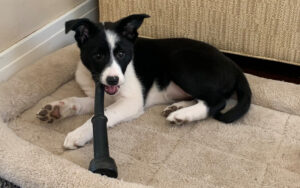
Teach your dog how to ring bell to go outside. Magnum, my 15-week-old Border Collie puppy, demonstrates three easy steps! This counts toward your Novice Trick Dog title through Kyra Sundance’s Do More With Your Dog (www.domorewithyourdog.com) program.

No Comments »

Advanced Trick: That Was Easy!

Magnum, only 14 weeks old, figures out how to tap an Easy button. Eventually, after he does a trick, my cue will be, “Was that hard?” and he’ll tap the button, “That was easy!” You can buy an Easy button from Staples for only $5.99.

2 Comments »

Novice dog tricks

Congrats to my students on earning their Novice Trick Dog title!

No Comments »

What’s Scent Detection? Watch Shelby’s nose at work!

No Comments »

Follow

Get every new post delivered to your Inbox.

Join 475 other followers